Political Aspirations in Germany and Europe
The three dimensions of sustainability
Sustainability has always been a central issue, particularly in the realm of political initiatives. For instance, the UN Conference on Environment and Development was held in Rio de Janeiro as early as 1992, where sustainable development was established as a guiding global principle. In 2015, the United Nations published 17 Sustainable Development Goals (SDGs), which apply to all countries worldwide and are part of the 2030 Agenda. TheseSDGs encompass, in particular, the three dimensions of sustainability. The diversity of the goals contained therein underscores that sustainability remains one of humanity’s greatest challenges while simultaneously offering immense potential for development. These dimensions should not be viewed in isolation but rather as mutually influencing one another, meaning that sustainability issues should always be addressed with due consideration of other interdependencies.
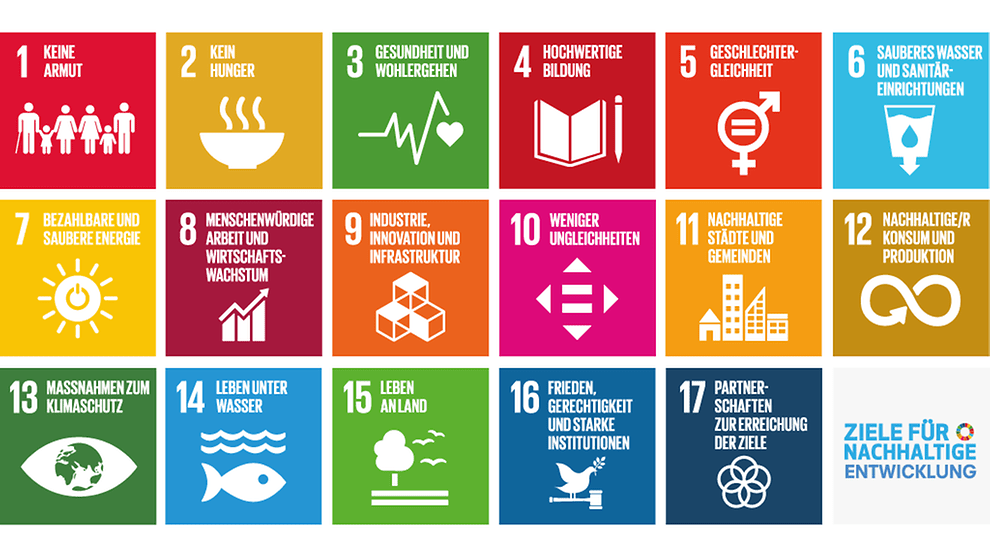
The 17 Sustainable Development Goals
Cradle to Cradle
The principle of the linear economy has been established for many decades: resources are extracted, used in the production of goods and services, and then, after use, either disposed of directly or recycled at great expense. But a shift is needed to achieve a better environmental footprint. This is the goal of the so-called “Cradle to Cradle” (C2C) principle. Developed in the 1990s, this innovative concept is gaining increasing traction in the business world because circular economy—as it translates into German—addresses the entire process from production all the way to consumers. Rather, the goal is to create a cycle in which nothing is lost and all resources can be reused or incorporated into another cycle without any loss of quality. Instead, all materials should be able to be reused without any loss of quality
Fit for 55
In 2020, the EU’s greenhouse gas emissions totaled approximately 3.4 billion metric tons of CO2 equivalents (Federal Statistical Office, 2023). This figure does not even take into account other harmful emissions and the various negative impacts of economic activity. With 37% of international travel volume in 2019 (Statista, 2023), tourism certainly makes a significant contribution to this as well. These figures are alarming and necessitate solutions—solutions that will become indispensable in the long term.
For this reason, the EU has set a target inthe European Climate Law to reduce net greenhouse gas emissions by at least 55% by 2030, with the aim of achieving climate goals through legal obligations and ultimately becoming climate-neutral by 2050. The title of the “Fit for 55” package is thus derived from these targets. These are to be achieved through legislation, initiatives, and measures stemming from an agreement between the Council of the EU and the European Parliament, which aims to maintain the EU’s competitiveness, ensure a level playing field for all countries, and position the EU as a role model in the global fight against climate change.
Google, as one of the GAFAM companies (Google, Amazon, Facebook/Meta, Apple, Microsoft), is setting an example by demonstrating what is already possible today. The company has been carbon-neutral since 2007, and by 2030, all of its data centers are expected to be powered by carbon-free electricity around the clock.
But progress toward sustainability cannot be achieved through technological innovations alone. The entire industry is facing increasing pressure from travelers to operate more sustainably and adapt its products accordingly; for the industry’s revenue giants—such as the cruise industry and the airline sector—this has now become the top priority. Yet the tourism industry is rising to the challenge and finding effective solutions.
Sustainability at the UNWTO
The UNWTO (United Nations World Tourism Organization) maintains that sustainable development goals and measures can be applied to all forms of tourism by taking into account at least the three dimensions of sustainability. It is therefore particularly committed to promoting sustainable tourism worldwide. These include measures such as promoting environmentally friendly modes of transportation, supporting local communities, and raising tourists’ awareness of environmental and cultural conservation. The organization also advocates for the protection of endangered animal and plant species, as well as the preservation of cultural heritage and natural sites. The UNWTO works closely with governments, NGOs, and the tourism industry to promote sustainable tourism development and minimize negative impacts. To this end, for example, the“Committee on Tourism and Sustainability”(CTS) was established.

“Tourism that takes full account of its current and future economic, social, and environmental impacts, addressing the needs of visitors, the industry, the environment, and host communities”
EU Taxonomy
The European Commission’s“European Green Deal”from 2020 is not only the talk of the town in the tourism sector, but is intended to apply to businesses of all sizes and across all industries. The goal of the so-called EU Taxonomy is to establish a sustainability classification for all activities and processes across all European economic actors, ultimately creating greater transparency and more favorable conditions for climate- and environmentally-friendly business practices in the EU, as well as achieving long-term objectives such as the reallocation of investments, CO2 reduction, or adaptation to climate change. With regard to the latter two, comprehensive reporting requirements have been an integral part of the taxonomy since January 1, 2022. Particular emphasis is placed here on the“Corporate Social Responsibility”(CSR) of companies, which must demonstrate their social responsibility for sustainable business practices.
Political Objectives in Germany
There are several policy decisions and initiatives in Germany aimed at promoting sustainability in tourism. Here are a few examples:
National Tourism Strategy: In April 2019, the federal government adopted the “National Tourism Strategy,” which, among other things, defines sustainability as a key pillar of tourism in Germany. After three challenging years, the strategy was expanded in 2022 to include additional key points to ensure that the necessary focus on the future is not lost. The National Tourism Strategy in Germany aims to strengthen tourism as an economic factor while making it sustainable. Specifically, the goal is to increase the number of overnight stays and the proportion of international guests by 2030, primarily by expanding digital infrastructure and further diversifying tourism offerings . At the same time, environmental impacts are to be minimized and social responsibility in tourism strengthened. This includes, among other things, promoting sustainable travel options and raising guests’ awareness of environmentally friendly behavior and the spirit of innovation.
Sustainable Tourism Strategy 2025: In addition to national efforts, individual states are also pursuing their own strategies tailored specifically to their local conditions. These strategies aim to shape local tourism in a way that minimizes environmental impact, supports the local economy, and meets the needs of both residents and tourists alike
Support for Sustainable Destinations: As part of the“Business-Related Tourism Infrastructure”program, the Federal Ministry for Economic Affairs and Energy provides funding for sustainable destinations in Germany. The goal is to strengthen the competitiveness of tourism regions and promote sustainable tourism.
Climate Protection in Tourism: The Federal Ministry for the Environment has launched various initiatives to promote climate protection in tourism. These include, among other things, support for projects that reduce CO2 emissions in tourism.
Certifications and labels: There are various certifications and labels for sustainable tourism in Germany, across Europe, and around the world.
These policy decisions and initiatives demonstrate that sustainability in tourism is an essential issue in Germany and has become an integral part of the government’s agenda.